Share:
Publications
Throughout the year, VOICE produces and disseminates key documents reflecting on humanitarian aid issues at the EU level and from an NGO perspective. They are addressed to decision-makers within the European institutions, at the National level, to NGO networks and other stakeholders of the humanitarian community, as well as to the VOICE members. Some documents are produced by the VOICE Secretariat with the support of VOICE members while others are publications from members and other key stakeholders in the humanitarian sector.
Please note that members-only documents will not be visible unless you are logged in.
-
11 for 11: GLOBAL EL NIÑO PROGRAM Appeal by Welthungerhilfe
07 October 2026Members' publicationsWHH together with its humanitarian partners has identified 11 at-risk countries across Africa, Asia and the Caribbean.
With EUR 11 million, WHH and its partners can scale up anticipatory and rapid response measures to reach an additional 1 million people - protecting lives, livelihoods and essential assets, preventing shocks escalating into humanitarian crises. -
Global Goals for a World in Conflict: What comes next in the fight against poverty
25 September 2026Members' publicationsGlobal Goals for a World in Conflict: What comes next in the fight against poverty -
VOICE Out Loud 41: What Must Not be Lost: Protecting People-Centered Humanitarian Action
28 August 2026VOICE out loudThe articles in this new edition of the VOICE out loud remind us that protection, education, mental health and psychosocial support, disability inclusion, and sexual and reproductive health and rights are not optional additions to humanitarian response but fundamental to principled, effective and people-centred humanitarian action. -
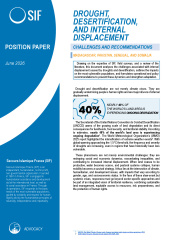
Drought, Desertification and Internal Displacement
25 August 2026Members' publicationsSIF - Position Paper “Drought, Desertification and Internal Displacement”. -
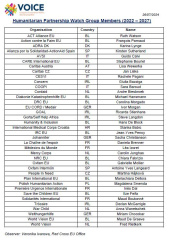
VOICE Humanitarian Partnership Watch Group members' list (2022-2027)
10 August 2026HP Watch GroupThe composition of the Humanitarian Partnership (HP) Watch Group for the 2022-2027 period. Updated in August 2026. -
“More than a human can bear”: Israel's systematic use of sexual, reproductive and other forms of gender-based violence since 7 October 2023
16 July 2026The Independent International Commission of Inquiry on the Occupied Palestinian Territory, including East Jerusalem, and Israel submits the present conference room paper to the Human Rights Council on the systematic use of sexual,reproductive and other gender-based violence by the Israeli Security Forces since 7 October 2023. -
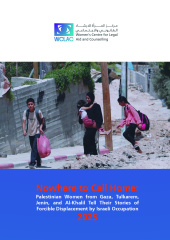
Nowhere to Call Home
16 July 2026Members' publicationsNowhere to Call Home: Palestinian Women from Gaza, Tulkarem, Jenin, and Al-Khalil Tell Their Stories of Forcible Displacement by Israeli Occupation -
Arming Injustice with Impunity
16 July 2026Members' publicationsArming Injustice with Impunity: How support for Israel’s illegal occupation and militarization undermines States’ commitments to gender equality and the WPS Agenda -
Joint Position Paper:Save Our NEAT+
16 July 2026Members' publicationsHumanitarian action is increasingly shaped by climate and environmental risks, yet the tools needed to assess and manage these risks are being weakened. Established instruments such as the Nexus Environmental Assessment Tool (NEAT+)—a widely used environmental screening tool—are at risk due to funding cuts and shifting priorities. This undermines project quality, increases long-term costs, and raises risks for avoidable environmental harm. As a fieldtested, user-friendly and standardised tool, NEAT+ plays a critical role in mainstreaming environmental considerations in humanitarian action. Without sustained support, the sector risks fragmentation, loss of expertise, and declining environmental standards. This paper calls on donors, leading humanitarian organisations, and policy makers to secure NEAT+ as a core humanitarian instrument by assigning dedicated, multi-year funding and advancing coordination mechanisms for its unified development. -
January 2026 Survey: Children’s Mental Health Assessment and War Impact in Lebanon
16 July 2026Members' publicationsThis document presents the results of a survey conducted in September 2025 assessing the mental health and wellbeing of children and their caregivers in war-affected areas of Lebanon, particularly in Beirut and Mount Lebanon. Respondents included 152 children and 143 caregivers. This survey aims to highlight gaps in access to mental health services and record caregiver and community testimonies of child wellbeing. -
Children Displaced Again in 2026 in Lebanon
16 July 2026Members' publicationsLebanon’s children are once again bearing the cost of war. Since hostilities reignited on 2 March 2026, at least 245 children have been killed and 957 injured in Lebanon (until 4 June). More than 390,000 children have been displaced — many for the second, third, or fourth time. This paper presents an evidencebased analysis of the protection risks facing displaced children in Lebanon, grounded in data from humanitarian sources and
supported by firsthand testimonies gathered by SIF through interviews with 38 displaced children and 6 caregivers under the Orphan Sponsorship Program. -

VOICE Statutes EN 2026
15 July 2026VOICE Activity ReportsVOICE Statutes in English, 2026. -
2016-2026: 10 years of attacks against healthcare
15 July 2026Members' publicationsA new report by Médecins du Monde France on 10 years of attacks against healthcare. This short report, produced to mark the 10th anniversary of United Nations Security Council Resolution 2286, which condemns attacks on healthcare in armed conflicts, shows, however, that such attacks remain a daily reality for MdM teams providing healthcare in conflict zones.
MdM France has documented 223 attacks on healthcare between 2016 and 2026 on our international operations, out of more than 1,000 incidents reported across our international programmes. This analysis was carried out using SYRIL, with the support from the Humanitarian Access & Risks service.
In several contexts (Myanmar, the Central African Republic, Palestine, Yemen, Ethiopia, Syria, Ukraine...), we have observed that peaks in incidents coincide with acute phases of conflict, highlighting a lack of respect for international humanitarian law.
This violence is part of an alarming global trend, with 17,000 attacks recorded worldwide since Resolution 2286, the majority of which (64%) are attributed to state actors. -

VOICE Statutes FR 2026
15 July 2026VOICE Activity ReportsVOICE Statutes in French, 2026. -
Home, but Not Whole: The Fragile Return and Reintegration of Syrian Returnees
07 July 2026Members' publicationsAs return-related policies accelerate—from national camp closure plans, to increasing pressures on refugees in neighbouring host countries and beyond—many Syrians are returning before the essential conditions for safe, sustainable, and dignified return are in place. Drawing on a survey of refugee and IDP returnees, focus group discussions, and expert interviews across seven governorates, this report offers critical evidence on the realities facing returnees and the urgent investments needed to ensure returns are voluntary, safe, and sustainable. -
FACTSHEET 2026: “Funding cuts turn inequalities into permanent exclusion”, a regional OPD from Sub-Saharan Africa
03 July 2026Members' publicationsEvidence from organisations of persons with disabilities on the human and organisational impacts of cuts to international humanitarian assistance.
At a time when global Official Development Assistance (ODA) has declined by 23.1% in 2025 (the steepest annual decrease ever recorded), the consequences are being felt most acutely by persons with disabilities, who are already among the world's most marginalized populations. The publication presents evidence gathered from 177 organisations of persons with disabilities (OPDs) across continents, documenting the profound human and organisational consequences of shrinking development and humanitarian aid budgets. -

Flash 6 - June 2026
01 July 2026VOICE FlashTable Of Contents:
All Eyes On Venezuela
VOICE General Assembly Highlights
Partners’ Dialogue 2026
VOICE’s updates on Supply Chain
MFF 2028 – 2034: Key advocacy milestones ahead
The World Bank at the Resilience-Nexus Working Group meeting
Updates on the Pilot Working Group on Localisation
Preparation for World Humanitarian Day
NCA/ACT EU event: (Re)building and Aid Ecosystem: When funding shrinks, who steps in?
Members' Publications and other Relevant Reports -
Cycles of displacement continue in Lebanon: NGO stories from families in limbo - Lebanon Humanitarian INGO Forum
29 June 2026Report on Cycles of displacement continue in Lebanon: NGO stories from families in limbo - Lebanon Humanitarian INGO Forum -
From Commitments to Principled Implementation: VOICE statement on the Joint Communication on Humanitarian Aid
12 June 2026VOICE statement on the recently adopted Joint Communication on Humanitarian Aid. A timely and politically significant initiative to strengthen EU humanitarian action in response to escalating global needs and shrinking humanitarian space. -
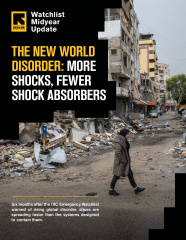
New World Disorder: More Shocks, Fewer Shock Absorbers
09 June 2026Members' publicationsIRC's newest repost "New World Disorder: More Shocks, Fewer Shock Absorbers". -
Risk-Sharing Frameworks in Humanitarian Partnerships
01 June 2026Members' publicationsA recent study by People in Need on Risk-Sharing Frameworks in Humanitarian Partnerships. -
VOICE Annual Report 2025
29 May 2026VOICE Activity ReportsVOICE Annual Report 2025. Read about the achievements and activities of the network over the last year. -
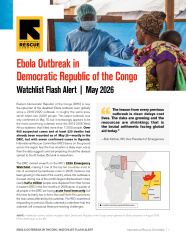
Emergency Watchlist Flash Alert: Ebola Outbreak in the DRC
28 May 2026Members' publicationsThe International Rescue Committee (IRC) warns that the rapidly escalating Ebola outbreak in eastern Democratic Republic of the Congo (DRC) could become the deadliest outbreak on record without urgent international action. -
VOICE at Work 10 - Spotlight on EU Humanitarian Action
18 May 2026VOICE at workTable of contents
VOICE Briefing: Diversity, Complementarity and Local Leadership in EU Humanitarian Action
VOICE calls for respect for International Humanitarian Law amid escalating violence in the Middle East
Humanitarian Action Works: A VOICE EU-wide communications campaign
Shaping EU Humanitarian Leadership in a Time of Crisis: VOICE sets priorities for the upcoming EC Humanitarian Communication
VOICE key highlights: VOICE - Global Focus roundtable in Copenhagen “Shaping the EU’s humanitarian and development agenda: From Lessons to Action"
VOICE Out Loud 40 "Fragility: The Cost of Inaction"
Interview with MEP Barry Andrews in the VOICE Out Loud #40
European Parliament DEVE Exchange: VOICE Director Highlights Humanitarian Principles and Funding Needs
VOICE Position Paper on Fragility
All Eyes on Gaza: Israel bans international NGOs amid deepening humanitarian crisis
Humming Word: A humanitarian term explained
VOICE Members' publications
Events and webinars -
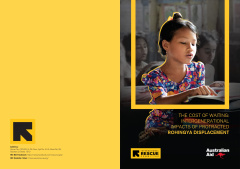
The Cost of Waiting: Intergenerational impacts of protracted Rohingya displacement
10 May 2026Members' publicationsThis study aims to generate evidence on how displacement has affected rights, protection, and resilience, while identifying critical policy and programming gaps. Specifically, it assesses the multidimensional impacts on both Rohingya and host communities, examines factors shaping social cohesion, explores the feasibility of repatriation, and provides evidence-based recommendations to strengthen protection, resilience, and empowerment for all affected groups.