Negobox November - Global Europe under pressure: humanitarian action protected, but the wider cuts raise concern
Global Europe under pressure: humanitarian aid protected, but the wider cuts raise concern
On 21 November, the President of the Council Antonio Costa presented an updated negotiating box for the EU's next long-term budget (MFF 2028–2034). While It contains a reassuring signal for humanitarian action, it is deeply concerning for other areas.
A welcome signal on humanitarian aid
The box reaffirms the €25 billion proposed by the European Commission for humanitarian action, within the overall Global Europe Instrument. VOICE welcomes this. It recognises that humanitarian needs are at a record level, and it confirms that the EU intends to keep its capacity to respond.
The signal matters. But it is not yet a guarantee. This figure is not in the Global Europe regulation and figures in a negotiating box are not final, so the €25 billion must be defended in every remaining stage of the negotiations.
A concerning picture for Global Europe
While humanitarian aid is maintained, the box proposes an overall cut of €39.2 billion (-20%) to the Global Europe Instrument compared with the Commission's proposal, which stood at €200.3 billion.
The wider heading that houses the EU's external action would lose €45.2 billion, a 21% reduction. The cuts fall across every geographic pillar: Sub-Saharan Africa, the Neighbourhood, Asia and the Pacific, the Middle East and North Africa, and the Americas and the Caribbean each face reductions of around 19%. The emerging challenges and priorities cushion, designed for unpredictable crises, would fall by 24%. The margin, the room that allows the EU to react when the unexpected arrives, would fall by 70%.
Why humanitarian advocates should worry about the whole envelope
Humanitarian action cannot be considered in isolation from the rest of external action. Humanitarian needs are increasingly driven by protracted crises, conflict and fragility. When development and peace funding shrinks, needs grow, and humanitarian organisations are left to do more with the same budget. In many of today's crises, relief is the last line of support after development and peace instruments have failed or withdrawn.
It is also worth recalling that the €25 billion represents only a very small increase compared with the current MFF spending, in a context where humanitarian needs have risen substantially. Both dimensions of the budget, humanitarian and the wider Global Europe Instrument, need to be protected.
What VOICE calls for
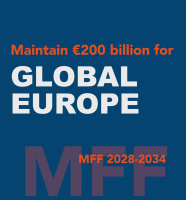
- Maintaining the €200 billion envelope for Global Europe, so that the EU can respond to growing crises in challenging geopolitical times, with humanitarian, development and peace action working together.
- Keeping the €25 billion for humanitarian aid as a guaranteed minimum, not a ceiling, in line with the position developed by the European Parliament.
- Protecting the emerging challenges and priorities cushion, with humanitarian needs explicitly listed as its first purpose.
- Preserving humanitarian assistance as needs-based and principled, not as a tool serving other EU priorities.
Next steps
VOICE will continue to follow the negotiations closely and to work with Member States, MEPs and the Commission to protect principled humanitarian assistance in the final agreement.